


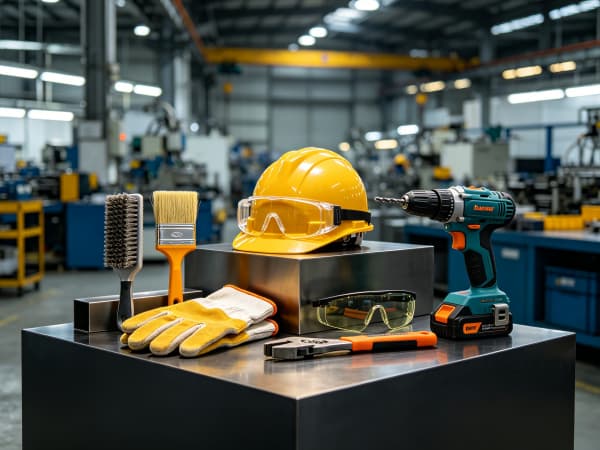
Learn how Sanjian Group has built an integrated hardware tool manufacturing system, delivering quality, innovation, and supply chain reliability through comprehensive product development and advanced production capabilities.
Article
The global hardware tool industry depends on manufacturers that can consistently deliver quality, product diversity, and reliable production. As international supply chains become increasingly complex, buyers also expect greater manufacturing transparency, stable quality control, and continuous product innovation.
Among the companies attracting attention in recent industry reports, Sanjian Group has demonstrated how integrated manufacturing and long-term investment in production capabilities can support global hardware markets. Since its establishment in 2003, the company has expanded from a specialized manufacturer into a diversified industrial group serving customers across multiple regions worldwide.
Rather than focusing on a single product category, Sanjian Group has developed a comprehensive manufacturing ecosystem covering industrial brushes, protective equipment, work gloves, hand tools, and power tools. This integrated approach reflects a broader trend in modern hardware manufacturing, where diversified production and standardized quality management contribute to stronger supply chain resilience.
What Makes an Integrated Hardware Tool Manufacturer?
An integrated hardware tool manufacturer manages multiple stages of product development and production within a coordinated manufacturing system.
Instead of sourcing products from unrelated factories, an integrated manufacturer typically controls:
- Product research and development
- Manufacturing engineering
- Production planning
- Quality inspection
- Product testing
- Export coordination
This structure helps maintain consistent production standards while improving communication between design, manufacturing, and quality assurance teams.
Sanjian Group operates through several specialized subsidiaries, including Zhejiang Pujiang Sanjian Tools Co., Ltd., Zhejiang Sanjian Brush Industry Co., Ltd., and Lanxi Maxman Tools Co., Ltd. Each company contributes technical expertise within its product category while benefiting from shared manufacturing resources and management systems.
How Advanced Manufacturing Supports Product Consistency
In hardware manufacturing, product quality depends on process control as much as raw materials.
Modern production facilities typically combine automated equipment with standardized inspection procedures to ensure consistency across large production volumes.
A typical manufacturing workflow includes:
- Raw material verification
- Component processing
- Automated or semi-automated assembly
- Surface finishing
- Functional testing
- Final quality inspection
- Packaging and shipment
Advanced production equipment improves dimensional consistency, while dedicated testing instruments verify product performance before shipment.
For products such as wire brushes, paint brushes, scrapers, safety gloves, and electric tools, inspection often includes appearance evaluation, dimensional measurement, functional verification, and durability testing according to applicable product standards.
A Diversified Product Portfolio Supports Multiple Industries
One characteristic of mature hardware manufacturers is the ability to serve different industries through complementary product categories.
Sanjian Group has developed a portfolio that includes more than 5,000 product SKUs, covering:
| Product Category | Typical Applications |
|---|---|
| Wire brushes | Surface preparation, rust removal, metal finishing |
| Paint brushes and roller brushes | Construction, decoration, maintenance |
| Cleaning brushes | Industrial cleaning and household applications |
| Work gloves | Manufacturing, construction, logistics |
| Protective equipment | Workplace safety and industrial protection |
| Hand tools | Masonry, repair, installation and maintenance |
| Power tools | Construction, fabrication and home improvement |
This broad product range enables distributors and industrial users to source compatible products across multiple categories while maintaining consistent quality expectations.
Instead of concentrating solely on consumer markets, the product mix also addresses industrial maintenance, construction, manufacturing, and professional trade applications.
Why Quality Management Remains a Competitive Advantage
In global manufacturing, quality consistency often influences long-term customer relationships more than individual product specifications.
Effective quality management combines preventive process control with systematic inspection throughout production.
Industry best practices commonly include:
- Incoming material inspection
- In-process quality monitoring
- Finished product testing
- Statistical process control
- Traceability documentation
- Continuous improvement analysis
According to publicly available company information, Sanjian Group maintains strict quality management procedures that help keep product defects below **0.3%**, supporting stable product performance across large production batches.
For export-oriented manufacturers, maintaining consistent quality is especially important because product replacement costs, shipping delays, and customer downtime can significantly affect supply chain efficiency.
How Innovation Strengthens Long-Term Manufacturing Capability
Innovation in the hardware industry extends beyond launching entirely new products.
Many manufacturers improve competitiveness through continuous refinement of existing designs, production technologies, and manufacturing efficiency.
Examples include:
- Ergonomic tool improvements
- Material optimization
- Enhanced durability
- Automated production upgrades
- Improved packaging efficiency
- Better production traceability
Continuous product development allows manufacturers to adapt to changing customer requirements without disrupting established production systems.
Sanjian Group has emphasized ongoing innovation across its product categories, developing practical solutions that respond to evolving market needs while maintaining manufacturing stability.
Long-Tail Insight: How Does Comprehensive Hardware Manufacturing Improve Global Supply Chains?
Global distributors increasingly seek manufacturing partners capable of supplying multiple product categories from coordinated production systems.
This approach offers several operational advantages:
- Simplified supplier management
- More consistent product quality
- Standardized packaging practices
- Better production scheduling
- Reduced coordination complexity
- Greater manufacturing flexibility
Integrated production also allows engineering teams to share manufacturing knowledge across different product lines, supporting continuous process improvement.
In large-volume production, standardized operating procedures help reduce variability while improving production efficiency across factories.
As international logistics continue to evolve, manufacturers with diversified production capabilities and mature quality systems are generally better positioned to respond to changing market demand.
Supporting Global Customers Through Manufacturing Excellence
Export success depends on more than production capacity.
Manufacturers serving international markets must balance product quality, engineering capability, production efficiency, and customer support.
Over more than two decades of development, Sanjian Group has expanded its presence across numerous international markets, establishing long-term cooperation with over 200 global customers.
This growth reflects a manufacturing strategy centered on:
- Comprehensive product development
- Advanced production equipment
- Standardized quality control
- Continuous innovation
- Long-term customer collaboration
Rather than relying on a single competitive advantage, the company combines diversified manufacturing expertise with integrated production management to support customers across construction, industrial manufacturing, maintenance, and consumer markets.
As demand for reliable hardware solutions continues to grow, manufacturers that invest in production technology, quality assurance, and product innovation are expected to play an increasingly important role in strengthening the global hardware supply chain.
FAQ
What is an integrated hardware tool manufacturer?
An integrated hardware tool manufacturer manages product development, manufacturing, quality inspection, and production coordination within a unified production system. This approach helps improve consistency and operational efficiency.
Why is diversified manufacturing important in the hardware industry?
Diversified manufacturing allows companies to produce multiple product categories under consistent quality standards. It also supports broader industry applications and improves supply chain flexibility.
How do hardware manufacturers maintain consistent product quality?
Quality is maintained through raw material inspection, standardized production processes, functional testing, statistical quality control, and final product inspection before shipment.
Which industries commonly use professional hardware tools?
Professional hardware tools are widely used in construction, industrial manufacturing, metal fabrication, facility maintenance, automotive repair, logistics, landscaping, and home improvement.
Why are innovation and manufacturing technology important for hardware companies?
Continuous innovation improves product durability, user experience, manufacturing efficiency, and production consistency. These improvements help manufacturers adapt to changing market requirements while maintaining stable product quality.