


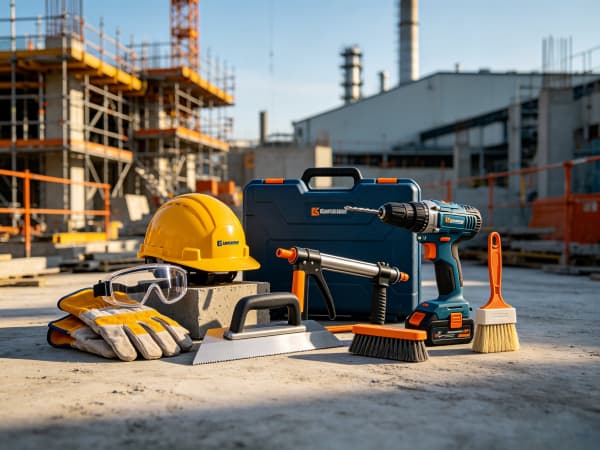
Engineering and infrastructure projects require more than individual hardware products. They depend on coordinated supply systems that deliver consistent quality, reliable performance, and compatibility across multiple product categories. As construction projects become larger and more technically demanding, many engineering companies are moving away from fragmented purchasing models toward integrated hardware solutions.
A recent overseas customization project completed by Sanjian Group illustrates how full-category hardware tool manufacturing can improve project efficiency for international engineering customers. The project involved supplying customized hardware tools and personal protective equipment (PPE) for a European engineering company responsible for construction and maintenance operations.
Rather than highlighting a single product, this case demonstrates how integrated manufacturing, application-specific customization, and standardized quality management can support complex engineering environments.
What Is a Full-Category Hardware Tool Customization Project?
A full-category hardware tool customization project combines multiple industrial product lines into one coordinated solution designed for a customer’s specific operating environment.
Unlike purchasing tools from separate suppliers, this model integrates product development, manufacturing, testing, and quality management under a unified production system.
Typical product categories may include:
- Industrial cleaning brushes
- Paint brushes and roller brushes
- Welding and work gloves
- Safety helmets
- Protective goggles
- Construction trowels
- Grout guns
- Electric drills
- Other hand and power tools
By standardizing production and inspection procedures across these categories, manufacturers can provide greater product consistency throughout the project lifecycle.
Why Engineering Companies Are Reducing Multi-Supplier Procurement
Large engineering projects often involve hundreds of consumables and tools.
When these products come from multiple manufacturers, project teams may encounter:
- Inconsistent product specifications
- Different quality standards
- Complex logistics coordination
- Longer purchasing cycles
- Increased inventory management
Integrated sourcing addresses many of these operational challenges.
Instead of coordinating several independent suppliers, engineering companies receive products that are designed, tested, and delivered within a unified manufacturing framework.
This approach can simplify project planning while improving consistency across construction sites.
How Customized Manufacturing Supports Real Project Requirements
Customization involves more than adding a customer logo.
For engineering projects, manufacturers typically evaluate how products will be used under actual working conditions.
The customization process often includes:
- Project application analysis
- Product specification review
- Material selection
- Prototype adjustment
- Functional testing
- Batch production
- Final inspection
In the featured European project, Sanjian Group customized multiple products according to the customer’s construction environment and operational requirements.
The customized solution included:
| Product Category | Engineering Application |
|---|---|
| Industrial cleaning brushes | Surface preparation and equipment maintenance |
| Welding gloves | Heat-resistant hand protection |
| Safety helmets | Construction site protection |
| Protective goggles | Eye protection during cutting and grinding |
| Construction trowels | Masonry and finishing work |
| Grout guns | Adhesive and sealing applications |
| Multifunction electric drills | Installation and maintenance tasks |
Each product category was adjusted to match the customer’s usage scenarios while maintaining consistent manufacturing quality throughout production.
Manufacturing Quality Is Built Into Every Production Stage
Reliable engineering tools begin with controlled manufacturing processes rather than final inspection alone.
Professional manufacturers generally implement quality management throughout production.
Key manufacturing stages include:
- Incoming material verification
- Process control during production
- Dimensional inspection
- Functional performance testing
- Surface quality evaluation
- Packaging verification
Advanced testing equipment allows manufacturers to identify production deviations before products enter mass shipment.
For industrial brushes, testing may evaluate filament retention, brush balance, and dimensional consistency.
Protective gloves are commonly assessed for abrasion resistance, seam integrity, and material performance according to applicable international standards.
Power tools typically undergo electrical safety verification, operational testing, and performance inspection before packaging.
According to the project information, all customized products supplied for the European engineering project met relevant European safety and environmental requirements, with stable field performance following delivery.
Application Scenario: Supporting Construction and Maintenance Projects
Engineering companies require products that function together rather than independently.
Construction projects frequently involve:
- Surface preparation
- Concrete finishing
- Equipment installation
- Maintenance operations
- Safety management
- Site cleaning
A coordinated hardware package helps standardize tools used across different teams while reducing compatibility issues.
For example, maintenance technicians may use cleaning brushes, electric drills, safety goggles, and protective gloves during the same workflow.
Construction crews may simultaneously require trowels, grout guns, helmets, and additional safety equipment.
Integrated product planning supports smoother project execution by ensuring equipment is available in compatible specifications.
Long-Tail Insight: How Do One-Stop Hardware Tool Solutions Improve Engineering Efficiency?
One-stop hardware solutions are becoming increasingly common in international engineering projects because they reduce operational complexity.
Compared with fragmented purchasing, integrated supply models may provide several practical benefits.
| Traditional Multi-Supplier Model | Integrated Supply Model |
|---|---|
| Multiple quality standards | Unified inspection system |
| Separate logistics schedules | Coordinated delivery planning |
| Independent technical support | Centralized engineering communication |
| Inconsistent product compatibility | Standardized product matching |
| Higher administrative workload | Simplified project coordination |
In large-scale construction projects, reducing supplier coordination often saves valuable management time while improving inventory visibility.
Integrated manufacturing also allows engineering teams to maintain greater consistency across different job sites.
Although every project has unique technical requirements, standardized manufacturing systems help reduce production variability while supporting long-term operational reliability.
A Practical Example of Integrated Industrial Manufacturing
The European customization project completed by Sanjian Group illustrates how diversified manufacturing capability can support complex engineering applications.
Rather than supplying individual products, the company combined customized industrial brushes, work gloves, safety equipment, hand tools, and power tools into a coordinated project solution.
Supported by dedicated engineering personnel, advanced production equipment, and standardized testing procedures, the project progressed from technical evaluation through batch production and final inspection with consistent quality management.
Following project completion, the customer simplified its previous multi-supplier purchasing model while improving procurement efficiency and reducing logistics coordination.
From an industry perspective, this case reflects a broader trend in global engineering supply chains: manufacturers with integrated production capabilities are increasingly supporting customers through coordinated product development, standardized manufacturing, and application-oriented customization.
As infrastructure projects continue to expand across international markets, full-category hardware manufacturing is expected to play an increasingly important role in improving supply chain efficiency and project reliability.
FAQ
What is a full-category hardware tool solution?
A full-category hardware tool solution combines multiple types of industrial tools and protective equipment into one coordinated manufacturing and supply system for a specific project or application.
Why do engineering companies prefer integrated hardware suppliers?
Integrated suppliers provide consistent product quality, unified quality management, coordinated logistics, and better compatibility between different product categories, reducing operational complexity.
What products are commonly included in engineering hardware packages?
Typical packages include industrial brushes, safety gloves, helmets, protective eyewear, hand tools, construction tools, power tools, and maintenance accessories.
How is customized hardware different from standard products?
Customized hardware is designed or adjusted according to project requirements, working environments, applicable standards, and operational needs while maintaining standardized manufacturing quality.
Why is quality testing important in engineering tool manufacturing?
Quality testing helps verify product safety, durability, dimensional consistency, and functional performance before products are delivered for demanding industrial applications.