


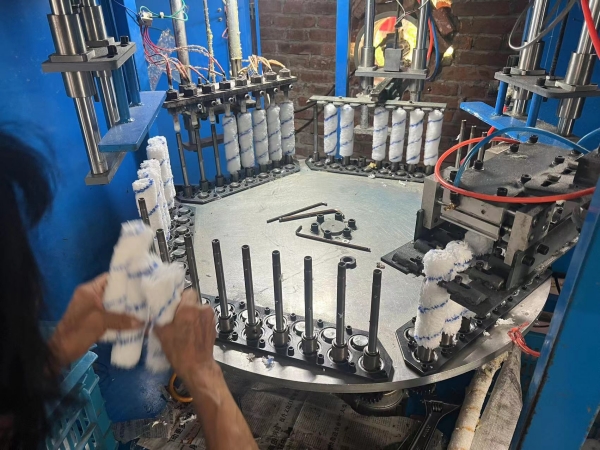
Manufacturing competitiveness is increasingly determined by production capability rather than production capacity alone. As global demand for reliable hardware tools continues to grow, manufacturers are investing in intelligent production systems that improve consistency, efficiency, and product quality.
In 2026, Sanjian Group completed a comprehensive upgrade of its intelligent production and testing facilities within its 12,000-square-meter standardized manufacturing base. The project focused on modernizing production for industrial brushes, work protection products, hand tools, and power tools through advanced manufacturing equipment and precision inspection technologies.
This upgrade reflects a broader trend across the hardware manufacturing industry: intelligent production is becoming a key driver of high-quality development rather than simply increasing output.
What Is an Intelligent Production Line?
An intelligent production line integrates automation, digital process control, precision equipment, and quality inspection into a connected manufacturing workflow.
Unlike traditional manual production, intelligent manufacturing continuously monitors each production stage, reducing variability while improving process stability.
A modern production line typically combines:
- Automated forming equipment
- CNC-assisted processing systems
- Robotic or semi-automatic assembly
- Digital production monitoring
- Precision inspection instruments
- Data-driven quality management
These technologies allow manufacturers to improve repeatability while maintaining stable production across different product categories.
Why Hardware Tool Manufacturers Are Investing in Smart Manufacturing
Hardware tools often require tight dimensional control, durable materials, and consistent assembly quality.
Traditional production methods may introduce variations caused by manual operation or inconsistent process control.
Intelligent manufacturing helps address these challenges by improving:
| Manufacturing Objective | Intelligent Production Benefit |
|---|---|
| Product consistency | Reduced process variation |
| Production efficiency | Faster manufacturing cycles |
| Quality inspection | Automated defect detection |
| Production planning | Standardized workflow management |
| Product traceability | Digital production records |
| Equipment utilization | Higher operational efficiency |
For manufacturers producing thousands of product variants, standardized automation also improves production flexibility while reducing unnecessary process interruptions.
How Intelligent Equipment Improves Manufacturing Quality
Manufacturing quality depends on controlling every stage of production rather than relying solely on final inspection.
Modern intelligent production lines typically optimize several key processes.
Product Forming
Automated forming equipment improves dimensional consistency while reducing deviations between production batches.
This is especially important for products such as brushes, molded safety equipment, and precision tool components.
Surface Processing
Intelligent polishing and finishing systems create more consistent surface quality while minimizing manual variation.
Uniform surface treatment also contributes to product durability and appearance.
Assembly Operations
Semi-automatic assembly stations standardize fastening, positioning, and component installation.
This improves repeatability across high-volume production.
Quality Inspection
Precision testing instruments verify critical product characteristics before shipment.
Inspection may include:
- Dimensional measurement
- Functional verification
- Surface quality evaluation
- Mechanical performance testing
- Electrical safety testing for power tools
Early-stage inspection allows manufacturers to identify production deviations before they affect large production batches.
Intelligent Manufacturing Supports Multiple Product Categories
One advantage of digital manufacturing systems is their ability to support diverse production requirements.
Following the production upgrade, Sanjian Group enhanced manufacturing capabilities across several core product lines.
These include:
| Product Category | Typical Manufacturing Focus |
|---|---|
| Industrial brushes | Bristle consistency and assembly precision |
| Work gloves | Material durability and seam quality |
| Safety equipment | Structural integrity and protective performance |
| Hand tools | Dimensional accuracy and surface finishing |
| Power tools | Assembly precision and electrical testing |
Although each product category follows different production processes, intelligent management systems help standardize quality control throughout the factory.
Why Precision Testing Is Essential in Modern Manufacturing
Inspection equipment has become as important as production equipment.
Without accurate testing systems, manufacturers cannot verify whether products consistently meet design specifications.
Modern testing laboratories commonly evaluate:
- Material properties
- Dimensional tolerances
- Functional performance
- Wear resistance
- Assembly accuracy
- Safety performance
For protective equipment, testing may assess structural strength and impact resistance.
Industrial brushes often undergo filament retention and balance evaluation.
Power tools generally require operational performance and electrical safety verification.
These inspections help ensure that finished products perform reliably under real working conditions.
Application Scenario: Supporting Customized and Large-Scale Production
Intelligent production systems benefit both standardized manufacturing and customized industrial projects.
Large engineering customers often require:
- Product specification adjustments
- Multiple product categories
- Consistent batch quality
- Stable delivery schedules
Digital production management makes it easier to coordinate these requirements while maintaining manufacturing efficiency.
According to company information, Sanjian Group’s upgraded production system has shortened both product customization and bulk production cycles through standardized process management and improved equipment utilization.
The same intelligent manufacturing capability also supported a recent customized project for a European engineering enterprise, where multiple hardware tools and protective products were manufactured according to customer-specific application requirements while meeting relevant European safety and environmental standards.
Long-Tail Insight: How Do Intelligent Production Lines Support High-Quality Development?
High-quality development refers to improving manufacturing capability through technology, process optimization, and continuous innovation rather than simply increasing production volume.
Intelligent production contributes to this objective by improving several operational indicators.
| Traditional Production | Intelligent Production |
|---|---|
| Manual process adjustment | Automated process control |
| Periodic quality checks | Continuous quality monitoring |
| Separate production records | Digital production traceability |
| Variable production efficiency | Standardized workflow management |
| Higher manual dependency | Better equipment coordination |
In large-volume production, standardized automation reduces production variability while improving overall manufacturing stability.
According to company data, Sanjian Group’s intelligent production upgrade has contributed to reducing the product defect rate to approximately 0.3%, reflecting improvements in process consistency rather than isolated product inspection.
As customer expectations continue to increase, manufacturers are investing not only in faster equipment but also in systems capable of supporting long-term quality improvement.
Continuous Innovation Drives Sustainable Manufacturing Growth
Production equipment alone cannot guarantee manufacturing excellence.
Long-term competitiveness also depends on engineering expertise, process optimization, and ongoing research and development.
Since its establishment in 2003, Sanjian Group has consistently emphasized technological innovation and equipment modernization as key components of its manufacturing strategy.
The company’s recent production line upgrade demonstrates how investments in intelligent equipment, precision testing, and standardized manufacturing management can strengthen both operational efficiency and product quality.
Looking ahead, continued investment in digital manufacturing technologies is expected to support future product innovation across industrial brushes, labor protection products, hand tools, and power tools.
As the global hardware industry continues its transition toward intelligent manufacturing, companies combining advanced production systems with disciplined quality management will be better positioned to support evolving industrial and engineering applications worldwide.
FAQ
What is an intelligent production line in hardware manufacturing?
An intelligent production line combines automation, digital monitoring, precision equipment, and quality inspection to improve manufacturing consistency, efficiency, and product quality.
How does automation improve hardware tool quality?
Automation reduces process variation, standardizes production operations, and enables continuous monitoring, helping manufacturers produce more consistent products across large production volumes.
Why is precision testing important in manufacturing?
Precision testing verifies that products meet design specifications, functional requirements, and applicable safety standards before shipment, reducing the risk of defects reaching customers.
Which hardware products benefit from intelligent manufacturing?
Industrial brushes, work gloves, safety equipment, hand tools, and power tools all benefit from automated production, digital process control, and standardized quality inspection.
How does intelligent manufacturing support customized production?
Digital production management allows manufacturers to adjust product specifications efficiently while maintaining consistent quality and production control across customized and standard product lines.